Mid-Air Collision Near Washington, D.C.: PSA Airlines CRJ-700 and Sikorsky UH-60 Black Hawk

American Airlines (PSA Airlines) Canadair CL-600-2C10 Regional Jet CRJ-701ER (Registration N709PS) - Photo Source: Colin Brown, CC BY 2.0
A midair collision occurred near Washington, D.C., on the evening of January 29, 2025, involving a PSA Airlines Canadair CL-600-2C10 Regional Jet CRJ-701ER (Registration N709PS), operating as American Airlines flight AA5342 and a U.S Army Sikorsky UH-60 Black Hawk (PAT-25). The helicopter did not transmit any ADS-B data.
The accident occurred over the Potomac River at approximately 9:00 p.m. local time while the CRJ-700 approached Runway 33 at Ronald Reagan Washington National Airport.
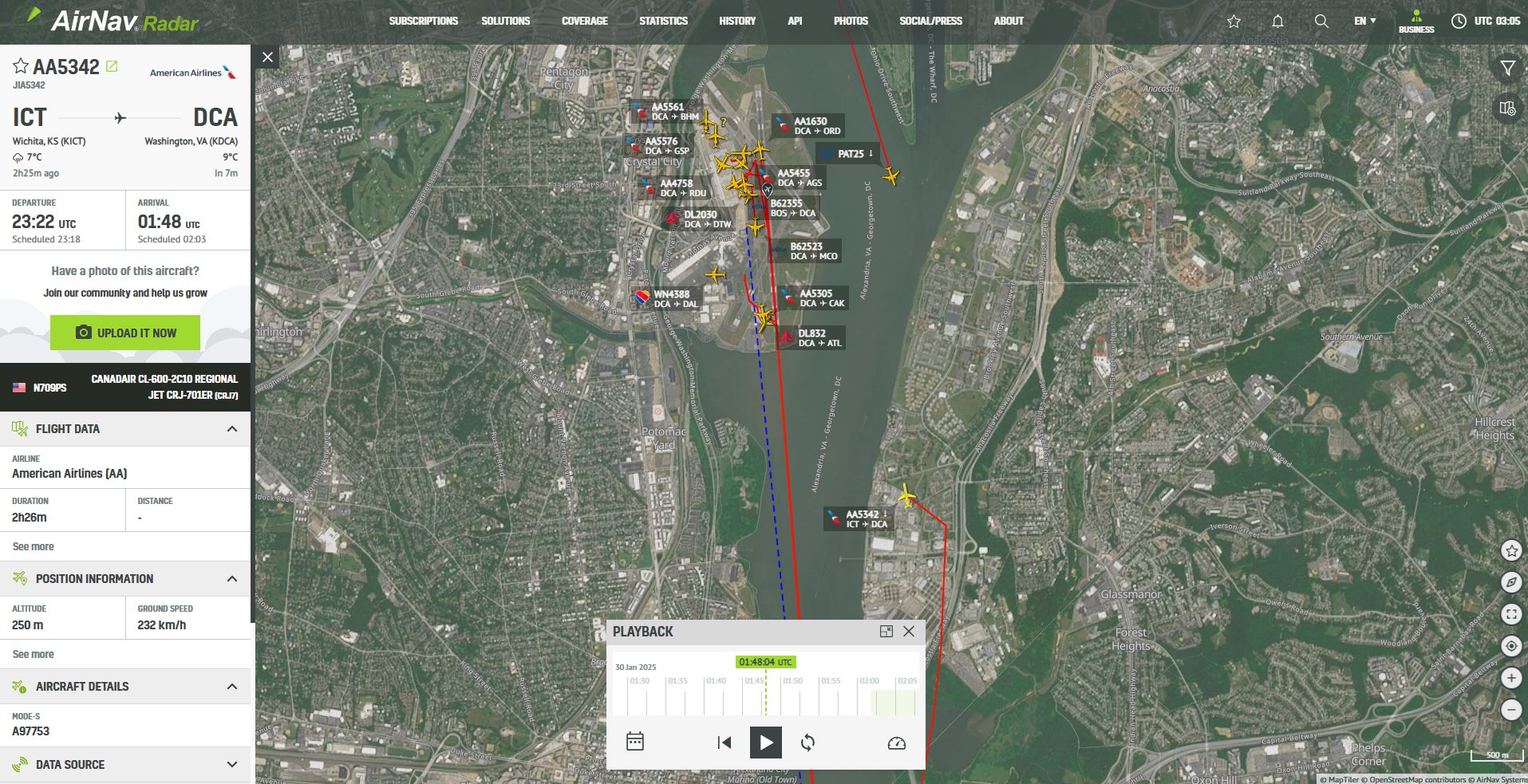
American Airlines flight AA5342 collided midair with a Sikorsky H-60 helicopter while approaching Runway 33 at DCA (Reagan National Airport)
Flight Details and Last Recorded Data
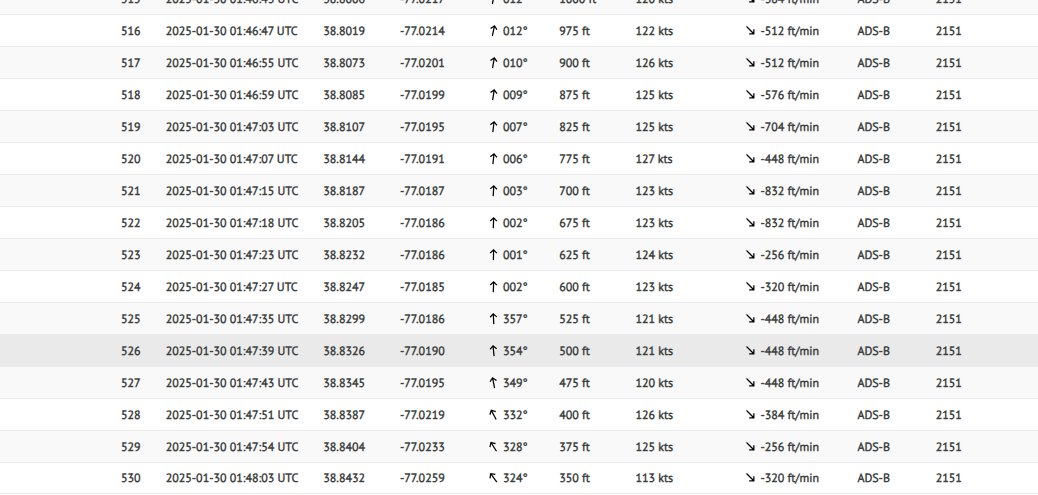
According to our data, the CRJ-700, registered as N709PS, was last recorded at 350 feet with a descent rate of minus 320 feet per minute. The aircraft’s ground speed at the time was 113 knots. The flight’s final log and playback can be accessed via the following links:
The CRJ-700, operated under American Eagle, can carry 65 passengers and has four crew members. The Sikorsky UH-60 Black Hawk, a military helicopter, can transport up to 15 personnel.
January 29, 2025
Just 24 hours before the tragic January 29 collision between a U.S. Army Sikorsky VH-60M Black Hawk and an American Airlines Bombardier CRJ-700 near Ronald Reagan Washington National Airport, another near-miss occurred involving the same type of helicopter.

On January 28, 2025, a Republic Airways Embraer E175-E1 operating as American Eagle narrowly avoided a collision with a VH-60M Black Hawk from the 12th Aviation Battalion, the same unit involved in the later accident. The Traffic Collision Avoidance System (TCAS) was triggered during this near-miss, highlighting potential safety concerns just a day before the fatal crash.
FAA and Authorities Respond
The Federal Aviation Administration has issued a statement confirming an investigation into the incident:
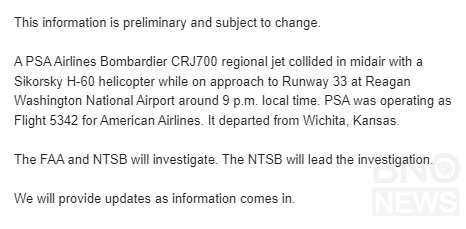
Emergency response teams were dispatched immediately to assess the situation and provide assistance. Details regarding casualties or survivors have yet to be confirmed.
Ongoing Investigation Updates:
February 1, 2025
The NTSB released further updates on recovered data and ongoing investigative efforts:
-
CRJ-700 Flight Data Recorder: Initial analysis shows the aircraft was approximately 325 feet ± 25 feet at the time of the incident. This altitude was determined using a combination of ADS-B and FDR data.
-
Air Traffic Control Radar Data: The altitude displayed on the air traffic controller’s radar scope indicated the CRJ at 200 feet. The NTSB will be working to verify this discrepancy on February 2 2, noting that radar scope altitude readings are less fidelity.
-
H-60 Recorder Status: The helicopter’s recorder also experienced water intrusion. Efforts are underway to dry the device before retrieving data, and results are expected within a day.
-
CVR and FDR Data from CRJ-700: The NTSB has successfully downloaded the FDR containing approximately 400 parameters. The cockpit voice recorder has also been analyzed, revealing a timeline of key events:
(All times in Eastern Standard Time)
- 20:45:27 – CRJ Autopilot disengaged
- 20:46:01 – ATC alerts PAT25 to CRJ south of Wilson Bridge
- 20:46:29 – CRJ reaches 1,000 feet callout
- 20:47:29 – CRJ reaches 500 feet callout
- 20:47:39 – ATC asks if PAT25 has the CRJ in sight
- 20:47:40 – Traffic Collision Avoidance System (TCAS) aural alert activates (“TRAFFIC, TRAFFIC”)
- 20:47:42 – DCA Tower instructs PAT25 to pass behind the CRJ
- 20:47:58 – CRJ crew verbally reacts, and the aircraft begins to pitch up
- 20:47:59 – Sound of impact recorded
The NTSB also confirmed that five air traffic controllers were on duty in the DCA tower at the time of the accident, including:
- 1 Local controller managing fixed-wing and helicopter traffic
- 1 Ground controller
- 1 Local assistant controller
- 1 Supervisor
- 1 Supervisor
February 3, 2025
The NTSB announced the successful extraction of data from the H-60’s combined flight data and cockpit voice recorder. Investigators now focus on synchronizing data from aircraft recorders, ATC communications, and radar records. Investigators manually reconstructed the timeline because the Black Hawk’s recorder did not contain timestamps.
February 4, 2025
The NTSB, in coordination with the Naval Sea Systems Command Supervisor of Salvage and Diving (SUPSALV), continued to recover wreckage from the Bombardier CRJ700 in the Potomac River. The following parts of the Bombardier CRJ700 have been recovered since the last update: right wing, center fuselage, part of the left wing and left fuselage, significant portions of the forward cabin and cockpit, vertical and horizontal stabilizers, tail cone, rudder, elevators, TCAS computer and quick access recorder. The recovered wreckage will be moved to a secure location for a wreckage layout examination.
NTSB has also been provided updated information that shows the air traffic control tower display at DCA is fed by the Potomac TRACON. The TRACON fuses information from multiple radar sensors and ADS-B data, providing the best quality flight track data to air traffic control. This data showed the Black Hawk was at 300 feet on the air traffic control display at the time of the collision. This data is rounded to the nearest 100 feet.
NTSB needs additional information to verify data points from the Black Hawk. In order to obtain this information, the Black Hawk needs to be recovered from the water, which is expected to take place later this week.
The aircraft systems group continued to review maintenance paperwork for the CRJ700 and the helicopter airworthiness group continued to review maintenance records for the Black Hawk.
NTSB investigators continue to transcribe the cockpit voice recorders for both aircraft. Synchronization work for the Black Hawk flight data recorder and cockpit voice recorder is ongoing.
February 6, 2025
The NTSB, in coordination with the Naval Sea Systems Command Supervisor of Salvage and Diving (SUPSALV), recovered today the Sikorsky UH-60 Black Hawk and additional parts of the Mitsubishi Heavy Industries (MHI) RJ Aviation (Bombardier) CRJ700 from the Potomac River. The team continues to search for additional parts of the Black Hawk including the right engine and tail rotor. The wreckage is expected to be offloaded from the barge tomorrow and transferred to a secure location.
As part of the recovery operation, the National Oceanic and Atmospheric Administration (NOAA) will be flying a TopoBathy lidar (light detection and ranging) scan flight overnight to scan the river floor. The scan will be used to potentially identify additional parts and items for recovery by divers or a crane. There will be a visible green light from the aircraft during the scan. The green light is not harmful to the eye.
NTSB investigators today examined the MHI RJ Aviation CRJ700 wreckage that has been recovered and secured. Flight data for both aircraft are being analyzed and parameters continued to be validated. Recovery operations will continue tomorrow in the Potomac River.
February 8, 2025
All major pieces of the Mitsubishi Heavy Industries (MHI) RJ Aviation (Bombardier) CRJ700 and the Sikorsky UH-60 Black Hawk involved in the Jan. 29 mid-air collision near Ronald Reagan National Airport have now been recovered to a secure airport facility for further examination and documentation. Investigators will be looking for witness marks on the aircraft that could provide clues to the angle of collision. Teams also recovered the CRJ’s Traffic Collision Avoidance System (TCAS) and retrieved additional avionics from the Black Hawk.
A National Oceanic and Atmospheric Administration TopoBathy lidar survey from a manned NOAA aircraft was conducted this morning and identified multiple underwater targets that could be additional aircraft debris. Divers investigated those targets today and will continue that work this week.